What is coil incense?
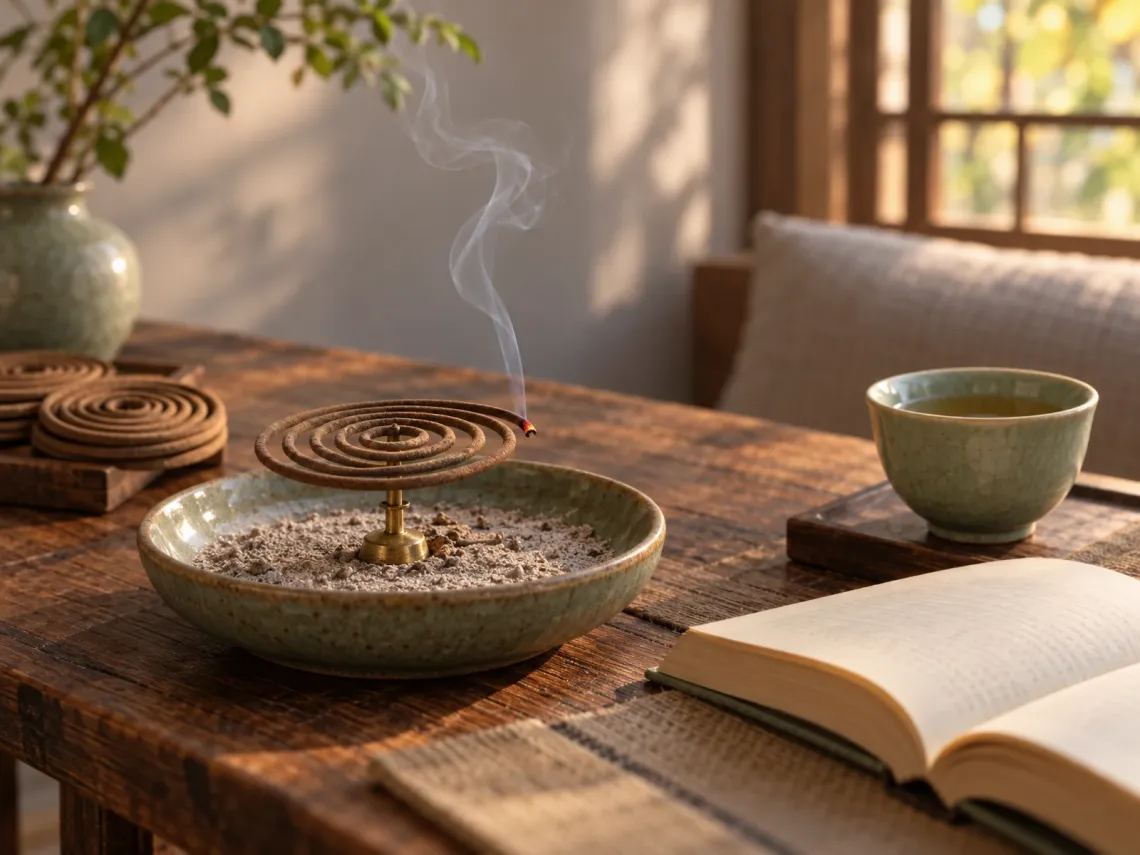
A slow afternoon. A book open on your lap, a cup of tea going cool beside it, and a thin thread of fragrant smoke curling upward without hurry.
Coil incense, also called spiral incense or incense coils, is incense paste formed into a flat spiral. You light it at the outer tip, and it burns slowly inward, releasing a steady, lasting fragrance.
People use it for home relaxation, as background fragrance during meditation, to set the mood for a tea ceremony, and in religious rituals in temples and homes across East and Southeast Asia.
One clarification: incense coils are not mosquito coils. Mosquito coils contain insecticides, commonly pyrethroids, and are designed to repel insects, not to scent a room. Never use one in place of the other.
Why does a spiral burn so long and so gently?
The spiral fits a long length of incense into a small footprint. That is why a coil burns much longer than a stick of similar weight.
A typical coil burns for about 2–4 hours. Very large hanging coils can burn for a full day or longer, which makes coils well suited to larger spaces. A larger format, such as these 4-hour oud coils, can carry fragrance through a whole afternoon.
Because a coil smoulders slowly, it releases fragrance at a relatively even, low level. Sticks give a sharper, shorter burst by comparison.
One coil can last through a long reading session, an unhurried tea ritual or a quiet meditation. Actual burn time depends on paste density, thickness, ingredients and airflow, so check the product label.
Where does coil incense come from?
Incense use in China is ancient, and incense culture flourished in the Song dynasty (960–1279). Coil incense is believed to have developed around the Song period, and it is reportedly sometimes called "dragon-hanging incense."
Production techniques are believed to have matured by the Ming dynasty (1368–1644), when coils became common in Buddhist rituals and daily life. Exact origin dates are not established.
Today, coils are used in Buddhist and folk temples, for ancestral worship and in homes. Some temples hang giant coils from the ceiling. Japanese makers also produce coil incense for longer sessions.
Sandalwood or agarwood: which scent should you start with?
Think of it as creamy and steady versus evolving and layered.
Sandalwood coils
Sandalwood incense is traditionally made from the heartwood of Santalum species, with Indian sandalwood as the classic source. Because supply is limited, Australian sandalwood and fragrance blends are also widely used.
The scent is mild, rich, slightly milky and woody. It is widely liked and an approachable first choice for daily relaxation, or for a calm atmosphere as you wind down in the evening.
Agarwood (oud) coils
Agarwood, or oud, is resin-rich heartwood from Aquilaria trees. Its scent evolves as it burns: fresh and light at first, then deepening into a rich, woody note.
In perfumery, "oud" can mean real agarwood or a synthetic oud-style accord, so check ingredient lists. All agarwood species are CITES-listed, and much agarwood today comes from cultivated trees.
Hoi An-type vs Singapore-type: what the labels mean
These are Chinese trade terms describing trade origin and scent style, not strictly where the wood grew. The scent notes below are connoisseur impressions, not lab standards.
- Hoi An-type: broadly Indochina-region wood. Sweeter, with a cool edge. Suits solo time in a study.
- Singapore-type: wood historically traded via Singapore from Indonesia, Malaysia and nearby regions. Warmer and full-bodied. Suits tea rooms and hosting guests.
Coil vs stick vs cone: which suits your space?
- Coil — Shape: spiral. Typical burn time: 2–4 hours. Smoke: gentle, steady. Best rooms: living rooms and tea rooms. Best use: long-lasting fragrance.
- Stick — Shape: straight, thin stick. Typical burn time: 30–60 minutes. Smoke: moderate. Best rooms: studies and bedrooms. Best use: short, versatile sessions.
- Cone — Shape: conical. Typical burn time: 15–30 minutes. Smoke: more. Best rooms: any room where you want visual ambience. Best use: a quick, strong burst of scent.
Sticks come in two styles. Cored sticks have paste around a bamboo core, common in Indian agarbatti. Solid sticks have no core and are common in Japanese and some Chinese incense.
Backflow cones have a hollow base. On a backflow burner, the smoke cools and sinks into a "smoke waterfall," best for ambience rather than long scenting.
Browse the full incense collection to compare formats. The short version: choose a coil when you want fragrance that lasts through an afternoon in a larger room.
How do you choose a good incense coil?
Reading the ash and the smell
Natural-material incense tends to leave greyish-white ash and a soft, non-irritating scent. Heavily synthetic-fragranced incense may leave darker ash and a sharp, pungent smell.
Treat this as a rough guide, not a lab test. Ash colour also depends on binders, wood type and additives. Read ingredient lists too, especially for products labelled "oud."
Choosing the right size
Coils of about 10–15 cm in diameter burn roughly 2–4 hours. Beginners should start small to medium so the scent does not overpower a room. A 2-hour oud coil is a good first step before moving to longer burns.
For a small room or bedroom, a shorter coil with good ventilation is usually more comfortable than a large one.
How do you light and place an incense coil?
- Coils are often sold pressed together in pairs or stacks. Separate them gently; they are fragile and can snap.
- Light the outer tip until it glows, then gently wave out the flame so the coil smoulders.
- Hang the coil by its centre from a hook or stand, or lay it flat on a raised holder, such as a metal mesh stand or heat-resistant tray.
A raised mesh lets air reach the underside so the coil burns evenly, and it catches the falling ash. A rosewood coil burner with a stainless steel mesh does both.
Place the holder on a stable, heat-resistant surface away from curtains, paper and fabric.
How should you store incense coils?
Keep coils sealed in a bag, tin or box, in a cool, dry place away from direct sunlight and strong odours.
Incense absorbs moisture and nearby smells. Damp coils are hard to light and may go out partway through. If a coil is slightly damp, sun-dry it for about 10 minutes before lighting. Never dry coils near flames or other strong heat sources.
Is coil incense safe to burn indoors?
Burning any incense releases fine particles and volatile compounds. Ventilation and moderation reduce exposure.
Ventilation
Keep a window slightly open or allow airflow. Avoid long burns in fully closed rooms, where smoke can build up and a heavy scent may cause dizziness.
Babies, pregnancy, sensitive airways and pets
Pregnant people, infants and anyone with asthma or sensitive airways should limit exposure. If the air feels stuffy or uncomfortable, put the coil out and open a window.
Birds and cats in particular have sensitive airways. Burn incense in a room your pet can leave, or skip it around them.
Fire safety
- Never leave burning incense unattended or burn it overnight.
- Use a proper holder, out of reach of children and pets.
- Make sure the coil is fully out before leaving the room.
A quiet afternoon, one coil at a time
Coil incense is a practical home fragrance and a small carrier of Eastern lifestyle aesthetics. Light a coil, open a book or pour tea, and let a slow, steady fragrance mark a calm pause in a busy day.
Coil incense FAQ
How long does coil incense burn?
Typically 2–4 hours. Extra-large coils can last a full day. Check the label.
Do I hang the coil or lay it flat?
Either works. Hang it by the centre, or lay it on a raised mesh holder.
Is coil incense safe indoors?
Yes, with ventilation, moderate use, a heat-resistant holder and supervision. Never burn it overnight.
Is it too strong for a bedroom?
Start with a small or medium coil, keep a window open, and put it out before sleeping.
How do I store incense coils?
Sealed, cool and dry. Sun-dry damp coils for about 10 minutes.
Are incense coils the same as mosquito coils?
No. Mosquito coils contain insecticide and are not for fragrance.