Does every agarwood tree contain oud?
Two logs can come from the same species, grow in the same forest, look alike from the outside, and still differ in value by a factor of hundreds. The reason is that one of them may hold oud and the other may hold nothing.
Oud comes from the Arabic al-oud, meaning "the wood." It is the trade name for agarwood, which is also sold as aloeswood, eaglewood, gaharu in Malay and Indonesian, jinko in Japanese, and chen xiang in Chinese. Chen xiang translates as "sinking fragrance."
Agarwood forms in trees of the genus Aquilaria and the closely related genus Gyrinops. Both belong to the family Thymelaeaceae, and both produce genuine agarwood. Their native range stretches from Assam in northeast India through Bangladesh, Myanmar, Thailand, Laos, Cambodia, Vietnam, Malaysia and Indonesia, up into southern China. Gyrinops also grows in Sri Lanka and reaches as far east as Papua New Guinea.
Here is the fact that explains most of what follows. Healthy heartwood in these trees is pale, light and almost scentless. A healthy tree contains no oud at all. Only a minority of wild trees carry a meaningful amount. You will often see figures such as "about 7%" or "under 10%," but these are estimates, not established data.
What actually causes the resin: injury, fungus, or both?
From the tree's side, oud is a scar. The process runs roughly like this:
- The tree is wounded by lightning, a snapped branch, boring insects or a cut.
- Fungi and other microbes move into the damaged tissue.
- The tree responds by producing a dark, aromatic resin in and around the injury to wall off the damage.
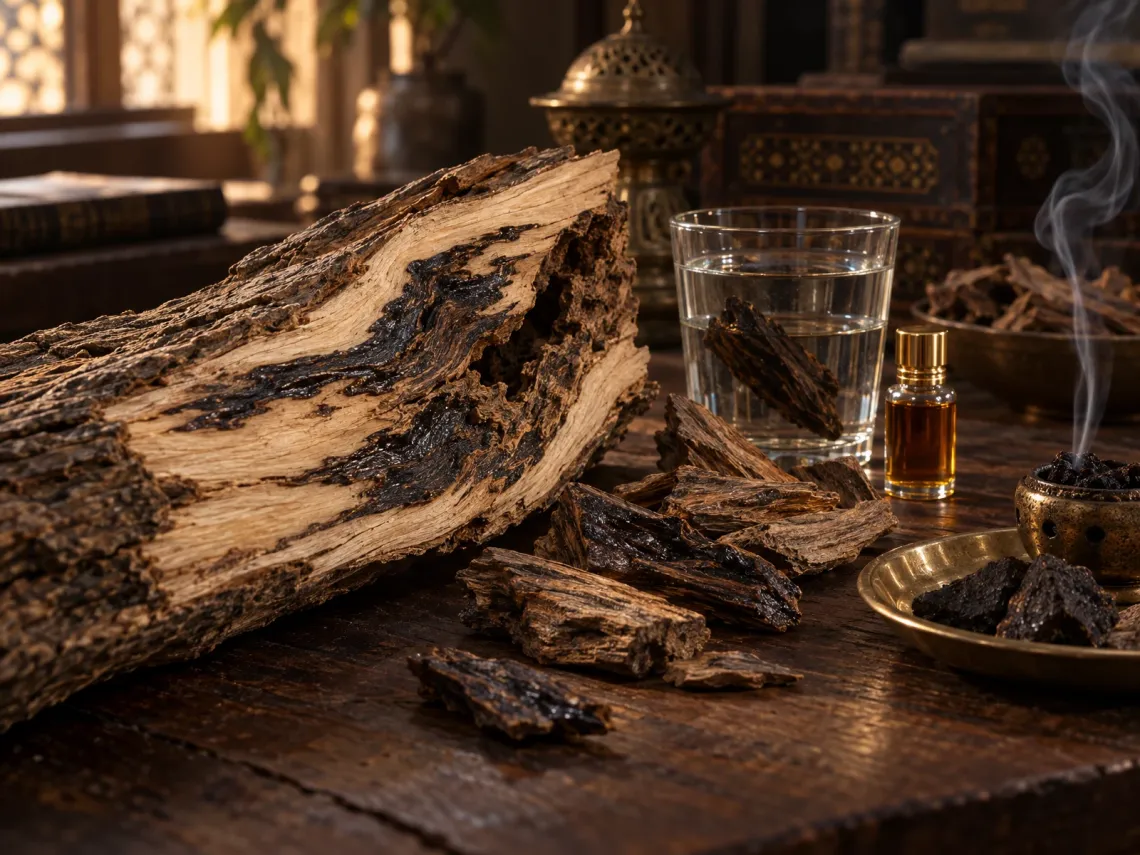
- Over time, that resin soaks into the surrounding wood, which turns darker, heavier and denser.
Studies of agarwood have found fungi such as Phaeoacremonium parasiticum and several Fusarium species in the resinous wood. Scientists still disagree about which organisms actually trigger resin and which simply live there. The working model is wounding combined with microbial activity.
The scent itself comes mainly from two groups of compounds: sesquiterpenes and 2-(2-phenylethyl)chromones. The chromones matter most when the wood is heated, because they shape the smoke you smell from a burning chip.
A quick reference for each stage:
- Wounding: healthy pale wood is damaged. For buyers: no resin yet, so no value as oud.
- Infection: microbes enter the injury. For buyers: the trigger is in place, but nothing is sellable.
- Early resin: dark streaks appear near the damage. For buyers: light, low-resin grades with a thinner scent.
- Saturation: resin fills the wood, which grows dark and heavy. For buyers: dense, high-grade material and the best oil yields.
How long does oud take to form?
No single figure is correct. Natural agarwood is often said to take decades, while some sources quote around ten years. The real timeframe depends on the trigger, the species, growing conditions and how much resin eventually accumulates.
Plantations shorten the wait by wounding trees on purpose. Growers drill holes, hammer in nails, apply chemical inducers or inject fungal cultures. One well-known approach is the inoculation kit associated with researchers at the University of Minnesota. Harvest usually follows a few years after treatment, though the exact interval varies from farm to farm.
Wild agarwood is generally regarded as more complex in scent. Cultivated quality ranges widely, and the better plantations are steadily improving.
Why does formation make oud so expensive?
- Few trees: only a small share of trees form usable resin, and you cannot tell which ones from the outside.
- Slow build-up: dense, resin-rich wood needs years to develop.
- Tiny oil yields: distillation turns a large mass of wood into very little oil. Traders often claim that about 70 kg of chips makes one tola of high-purity oil. Treat that as an unverified trade figure. A tola is roughly 11.66 g and is usually sold as about 12 ml.
- Scarcity and regulation: wild stocks have fallen sharply. Every Aquilaria and Gyrinops species is listed in CITES Appendix II, so international trade requires permits.
- Labour: wood is chipped by hand and soaked for days or weeks, and a single distillation can run for several days.
How can you read quality from formation clues?
Because resin changes the wood physically, formation leaves evidence you can check yourself.
Sinking grade and density
Wood that is thoroughly saturated with resin becomes heavy enough to sink in water. That is where "sinking" grades come from: chen xiang in Chinese, and often ghariq or gharqi in Gulf trade. Density is a real signal, but only when the weight comes from natural resin.
Look closely at colour as well. Good wood shows dark resin veins running through a lighter background, following the grain. Be wary of colour that sits evenly on the surface, as if painted on.
The heat test tells you the most. Warm a small chip gently instead of scorching it. An electric bakhoor burner with adjustable heat makes this easier than charcoal. Good agarwood releases a layered scent that shifts as it warms. A flat, sharp or perfumey smoke is a warning sign.
Signs of treated or fake chips
Chips can be soaked in oil, dyed, or weighted so they look darker and heavier than they are. Oils can be cut with synthetics. Darkness and weight on their own prove nothing. Oily residue on your fingers, uniform colour and a loud, simple smell all deserve suspicion.
There is also no universal grading standard. "Super," "A+" or "royal" mean whatever a particular trader decides they mean. Always ask what a seller's grade actually describes.
Why do oud oils from India, Cambodia or Malaysia smell different?
Species, the type of trigger, the age of the resin and local soaking or fermentation methods all shape the finished oil. Assam oils are often described as animalic or "barnyard." Cambodian and some other Southeast Asian oils tend to read sweeter and fruitier. Treat these as broad tendencies, not rules.
Processing matters as much as origin. Longer fermentation and slow heating tend to deepen certain notes, so the same wood distilled two different ways can smell clearly different. Sample oils and trust your nose rather than the country printed on the label.
Chips, oil, bakhoor or oud perfume: how does each relate to the raw wood?
Oud chips (dukhoon) are the resinous wood itself, heated on charcoal or an electric burner. Heat releases the chromone-rich smoke described earlier. If you use chips regularly, a dedicated bakhoor burner gives you steadier, gentler heat.
Oud oil is the distilled concentrate. Because the yield is so low, it is the most expensive form per gram.
Bakhoor is a different product. It is blended incense made from wood chips or sawdust soaked in oils and other aromatics. Oud may be one ingredient among several.
Oud incense sticks and coils are a convenient everyday way to scent a room. Their aroma depends on the blend, so browse an incense selection by scent profile rather than by name alone.
Oud perfumes: many Western "oud" fragrances rely mainly or entirely on synthetic oud accords. Check the ingredient list or ask the brand directly instead of assuming natural agarwood is inside.
What should you ask a seller before buying?
- Is it wild or cultivated? Which species, and from which country?
- For wood: is it untreated, and what exactly does your grade name mean?
- For oil: is it pure, and how was it distilled?
- For cross-border purchases: is the agarwood CITES-compliant?
The last question matters more than it may seem. Several Aquilaria species are assessed as threatened by the IUCN, and A. crassna and A. malaccensis are reported as Critically Endangered. Responsibly sourced plantation agarwood takes pressure off the remaining wild trees. Choosing it lets you enjoy oud without contributing to the loss of the forests it comes from.